Musselmonitor
Examples
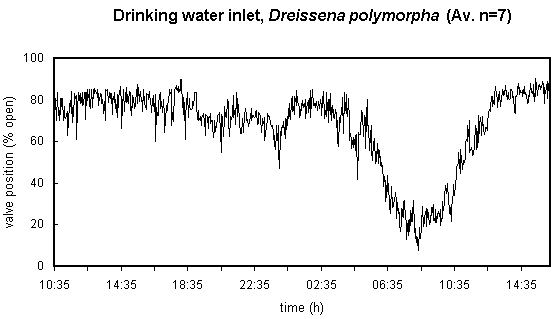
Based on true measurements, you find below an example of the monitoring of a drinking water inlet. The opening of all 8 mussels is measured every 1 min. The absolute values (mV) are converted into a percentage open, based on all-time minimum and maximum readings (0% = closed, 100% = open).

In figure above the response of 7 mussels (one sensor suffered from a technical problem) is presented as function of time (1.5 days period). One can clearly see that all are about 70-80% open most of the time, a normal feature. Sometimes, a mussel will close for a short period. Experience learns that a situation where more than a few mussels close for several minutes at the same time is highly improbable. So when 4 or 5 mussels close at the same time for some minutes (criteria can be set by the user) this is a clear indication of an alarming condition (which may result in the closure of an alarm switch).
Such an alarming condition can be seen in the figure around 06:30 h. Several mussels close fully, others have at least a decreased valve opening (as we measure individual mussels, differences in individual behaviour can be expected).
Does this figure look confusing to you? In the figure below, where we took the same data set and plotted the average of all 7 mussels. Now the random movement is averaged out and the clear 'alarm' condition is visible. There is no need to interpret plots: a display programme is present and the Musselmonitor can even be set to sound an alarm when the level drops below a certain value (e.g.) 25%.
More info about Mermayde or about the Musselmonitor? Contact us.